
Table of Contents
Minimalism for Small Spaces: How to Create Calm in Apartments
Living in a small apartment magnifies everything.
Clutter feels heavier. Layout mistakes feel tighter. Storage decisions feel permanent.
Minimalism for small spaces isn’t about making your apartment look empty, it is about designing it so every square metre works intentionally.
If you’ve already started to declutter your home, you’ve likely noticed how much lighter a room feels once excess is removed. But reduction alone isn’t enough. Layout, storage and furniture must work together.
This guide explains how to create calm in apartments using practical minimalism, not aesthetic trends.
Minimalism for Small Spaces: Quick Start
- Reduce before you reorganise
- Keep walkways clear
- Choose multi-functional furniture
- Prioritise closed storage
- Create simple return zones
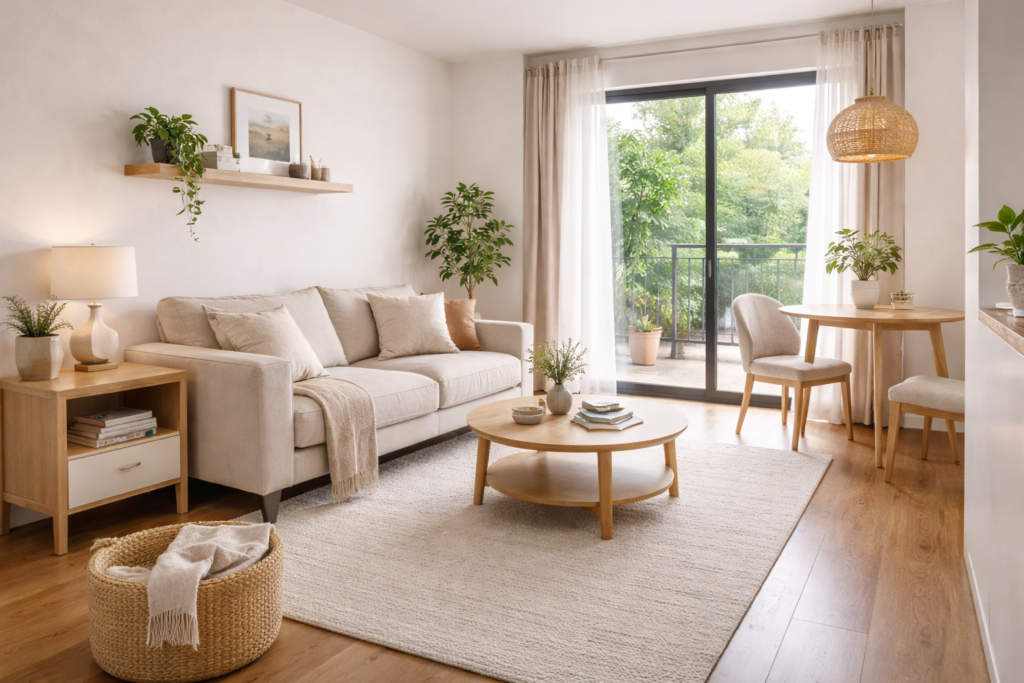
Why Minimalism for Small Spaces Works So Well
In larger homes, clutter spreads out.
In small apartments, it concentrates.
Research published in Personality and Social Psychology Bulletin found that individuals who described their homes as cluttered experienced higher stress levels compared to those who described them as relaxing.
When space is limited, visual noise increases faster. Fewer surfaces mean less margin for disorder.
Minimalism works in small homes because it reduces crowding and mental overwhelm.
Step 1: Reduce Before You Rearrange
The biggest mistake in apartments is rearranging clutter instead of removing it.
Before buying shelves or storage containers:
- Remove duplicates
- Eliminate rarely used items
- Group categories
- Question “just in case” purchases
As explained in How To Declutter Your Home Without Regret, reduction must come before organisation.
Small spaces amplify excess immediately.
Step 2: Design Around Movement Flow
In compact homes, movement is everything.
Ask yourself:
- Can I move freely without sidestepping furniture?
- Does furniture block light sources?
- Are pathways clearly defined?
Good flow makes a small apartment feel larger without changing its size.
This connected approach mirrors our Home Office Setup Guide, where layout supports habits and workflow instead of perfect alignment.
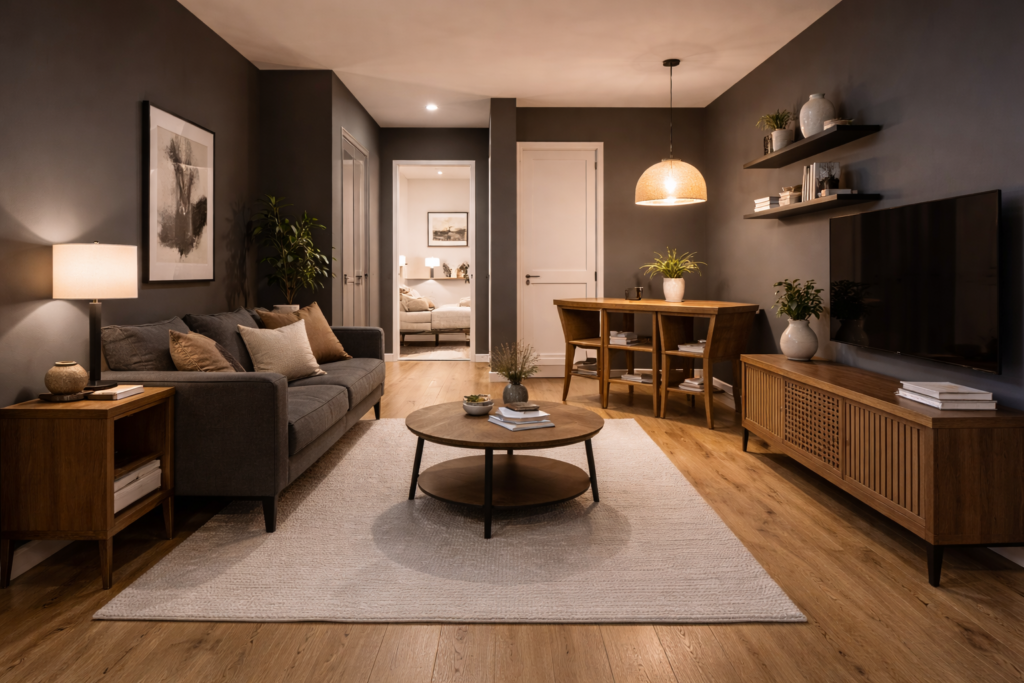
Step 3: Choose Multi-Functional Furniture
In small homes, every piece must earn its place.
Look for:
- Beds with built-in drawers
- Foldable or wall-mounted desks
- Extendable dining tables
- Storage ottomans
- Slim console tables
Research investigating multifunctional furniture in small residential spaces finds that these designs can improve space sustainability, functionality and overall living comfort by offering multiple functions within limited areas.
When furniture performs multiple functions, storage demand decreases.
If you’re unsure what furniture integrates best into small work areas, our Minimalist Storage Ideas That Actually Work guide explains how to build low-maintenance systems.
Step 4: Prioritise Closed Storage
Open shelving looks beautiful in spacious rooms.
In small apartments, it increases visual load.
Closed storage:
- Reduces overstimulation
- Simplifies cleaning
- Makes rooms feel calmer
- Minimises visual fragmentation
Minimalism for small spaces depends heavily on visual control. Even well-organised open shelves can feel busy when square space is limited.
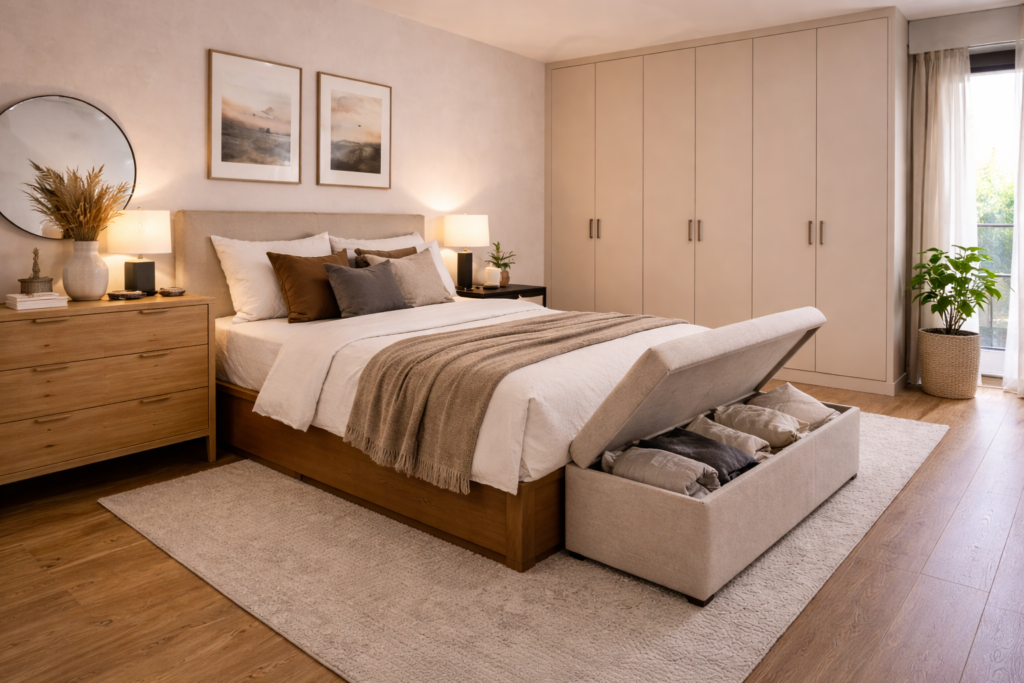
Step 5: Limit Visual Contrast
Small spaces benefit from visual harmony.
Focus on:
- Soft neutral palettes
- Limited colour variation
- Consistent materials
- Controlled decorative layering
Research exploring the role of interior design in mental well-being shows that environments with reduced visual complexity and clear spatial organisation support cognitive function and emotional comfort by lowering cognitive load and stress responses. This helps explain why visual cohesion, soft palettes, limited contrast and consistent materials makes small spaces feel calmer and more spacious.
Visual simplicity creates a sense of space.
Step 6: Use Vertical Space Intentionally
When floor space is limited, vertical structure matters.
Use:
- Wall-mounted shelves
- Slim cabinets
- Hooks
- Floating desks
Avoid overcrowding walls. Overuse of vertical storage can create a cramped look.
Intentional design feels light. Excess feels heavy.
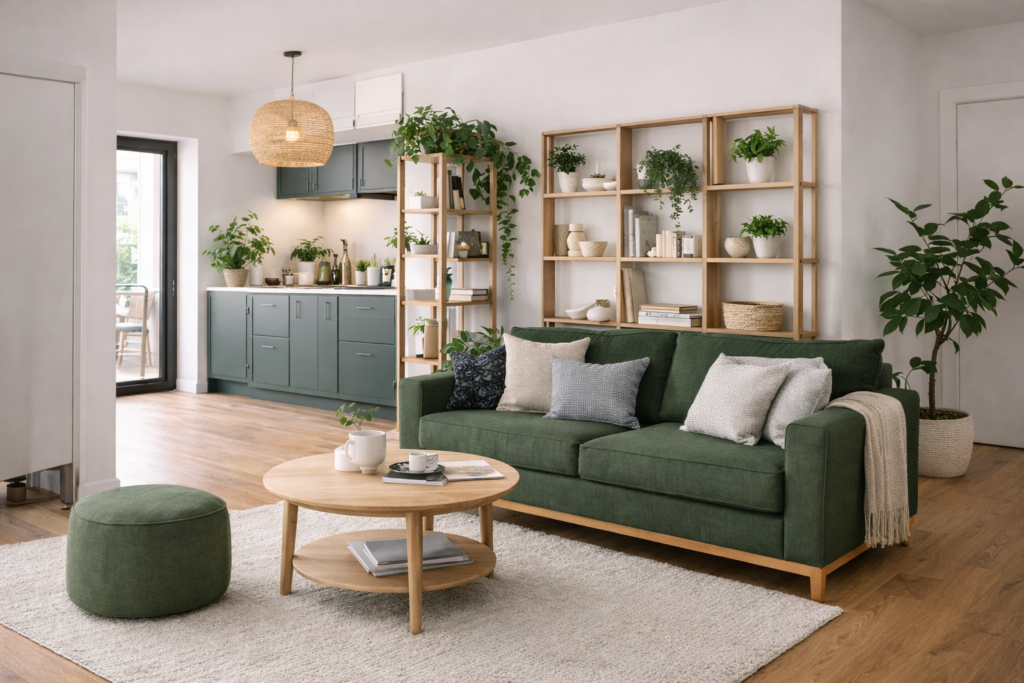
Step 7: Establish Clear Return Zones
Small apartments stay organised when everything has a designated return point.
Examples:
- A tray near the entrance for keys
- A drawer for technology
- A single basket for daily essentials
- One shelf for current reading material
Research from the Australian College of General Practitioners explains that clutter and disorganisation can overload the brain, increase stress and reduce focus and productivity. This supports the idea that having clear return zones, specific, predictable places for keys, tech and essentials helps routines run more smoothly and reduces mental effort in everyday life.
If putting something away requires thought, the system is too complex.
Common Minimalism Mistakes in Apartments
Copying Large-Home Minimalism
Small spaces require different proportions and fewer focal pieces.
Using Too Many Small Storage Containers
Too many bins create a mismatched space.
Keeping Furniture “Just in Case”
Furniture occupies the most volume, be selective.
Decorating Before Simplifying
Structure should come before styling.
How Minimalism for Small Spaces Supports Daily Life
When small homes are simplified intentionally:
- Cleaning becomes faster
- Movement becomes smoother
- Storage becomes intuitive
- Stress decreases
- Maintenance requires less energy
Minimalism for small spaces is not about aesthetic restraint.
It’s about functionality within limitation.
If you’re just beginning, start with Home Minimalism 101, which explains the philosophy behind structured simplicity.
Frequently Asked Questions
Is minimalism for small spaces necessary in apartments?
Not mandatory, but apartments benefit significantly from intentional reduction and structured layout.
How do I make a small apartment feel bigger?
Reduce visual noise, prioritise closed storage, improve flow and limit furniture volume.
Can minimalism feel warm in small spaces?
Yes. Natural textures, warm lighting and soft materials prevent minimalism from feeling sterile.
What’s the first step toward minimalism in a small apartment?
Declutter first, then design layout around movement and behaviour.
Final Thoughts
Minimalism for small spaces works best when reduction, layout and storage function as one system.
When furniture, movement and visual control align, even the smallest apartment can feel calm.
Small space living doesn’t require perfection.
It requires intention.